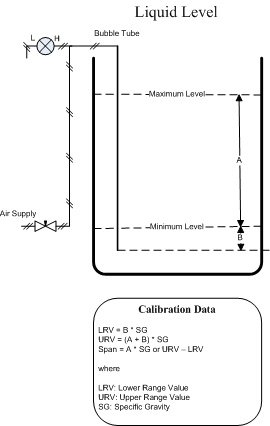
With all the new-fangled multifunction instrumentation available nowadays, it is easy to forget about the old tried and true measurement techniques. I believe the old adage, "the simplest solution is usually the best solution." For example, I like the simplicity and elegance of a bubble tube. A bubble tube is a tube (typically ¼ inch to ¾ inch tubing or pipe) that is inserted into a tank a fixed distance from the bottom. The liquid is pushed out of the bubble tube with air or nitrogen, which is metered through a purge meter. The resulting backpressure is proportional to liquid level or density and is usually measured with a differential pressure transmitter. Bubble tubes can be used to measure liquid level, interface level, and density in open tanks.
I show the transmitter at the top of the tank in the following figure, but it and the purge meter can be located anywhere. Referring to the figure, suppose A = 100 inches, B = 20 inches, and the liquid specific gravity is 0.8. The transmitter's lower range value (LRV) is 20 * 0.8 = 16 inches of water. The transmitter's upper range value is (100 + 20) * 0.8 = 100 inches of water. Therefore, the transmitter's calibration range is 16 - 100 inches of water. However, I usually make B = 0, which makes A = 120. In that case, the calibration range is 0 - 100 inches of water.
If the overall tank level remains constant, as with a constantly overflowing tank, a single bubble tube can be used to measure interface level. Referring to the following figure, suppose A = 100 inches, B = 20 inches, SG1 = 0.8, and SG2 = 1.0. The transmitter's lower range value (LRV) is (100 * 0.8) + (20 * 1.0) = 100 inches of water. The transmitter's upper range value (URV) is (100 + 20) * 1.0 = 120 inches of water. Therefore, the transmitter's calibration range is 100 - 120 inches of water.
.png)
In many cases, however, a tank's overall level varies several inches as its incoming flow varies. This variation induces significant error in the measured variable. In the previous example, the transmitter's span is 20 inches of water. An overall level change of only two inches (the radius of the overflow pipe, for example) will cause about ten percent error. The following two tube system will eliminate the error.
An interface level system with two bubble tubes will eliminate the error caused by a varying tank level. The second bubble tube is connected to the low side of the transmitter. As the overall level changes, the resulting backpressure is applied to both the high side and low side equally, thereby canceling the error.
Referring to the following figure, suppose A = 100 inches, SG1 is 0.8, and SG2 is 1.0. The transmitter's lower range value (LRV) is 100 * 0.8 = 80 inches of water. The transmitter's upper range value (URV) is 100 * 1.0 = 100 inches of water. Therefore, the transmitter's range is 80 - 100 inches of water.
.png)
As with interface level, if the overall tank level remains constant, a single bubble tube can be used to measure density. Referring to the following figure, suppose A = 100 inches, SG1 = 0.8, and SG2 = 1.0. The transmitter's lower range value (LRV) is 100 * 0.8 = 80 inches of water. The transmitter's upper range value (URV) is 100 * 1.0 = 100 inches of water. Therefore, the transmitter's calibration range is 80 - 100 inches of water. For the best accuracy, make length A as long as practical, since length A determines the transmitter's span.
.png)
Once again, a tank's overall level may vary several inches as its incoming flow varies, and this variation induces significant error in the measured variable; hence, consider using the following two tube system instead.
A density system with two bubble tubes will eliminate the error caused by a varying tank level. The second bubble tube is connected to the low side of the transmitter. As the overall level changes, the resulting backpressure is applied to both the high side and low side equally, thereby canceling the error.
Referring to the following figure, suppose A = 100 inches, SG1 = 0.8, and SG2 = 1.0. The transmitter's lower range value (LRV) is 100 * 0.8 = 80 inches of water. The transmitter's upper range value (URV) is 100 * 1.0 = 100 inches of water. Therefore, the transmitter's calibration range is 80 - 100 inches of water. For the best accuracy, make length A as long as practical, since length A determines the transmitter's span.
.png)
If you need to measure the level, interface level, or density in an open tank, consider using a bubble tube. You probably have everything needed in stock: a purge meter, a differential pressure transmitter, and some tubing. You can have it implemented in no time, and it will be accurate, reliable, and easy to maintain.